
A fairy story? Not quite.
A woman falls ill. Her husband starts questioning whether she’s really his wife. Relatives gather, remedies are brought in, and an ordinary cottage becomes the setting for something that sounds like a nightmare.
But Bridget Cleary wasn’t a character in an Irish fairy tale. She was a woman in County Tipperary whose death in March 1895 became an international newspaper story. The surviving reports describe forced treatment, an identity test, violence, and attempts to explain her disappearance. [S01]
My Irish ancestors came from the same county, which is what first caught my attention. Then I started reading the newspaper accounts. There was much more here than the short version about a husband who thought his wife was a changeling.
If you’ve watched our Historical Ramblings video, you’ll recognize the bread and jam, the questions about her name, and the reference to the peelers at the window. But what did those things mean to the people in that cottage? Why would someone throw urine on a sick woman? And where did the idea of a witch fit into a story about fairies?
Let’s pull up a chair and follow a few of those threads. The clippings are here for you to explore too.
Bridget had a life before she became a headline
Historian Angela Bourke identifies Bridget’s parents as Patrick Boland, a farm laborer, and Bridget Keating. Bridget earned money through dressmaking and selling eggs. In August 1887, she married Michael Cleary, a cooper, meaning a maker of barrels. Between them, they had skills people needed and work that connected them to the surrounding community. [S02]
I like starting here because it gives us someone to picture beyond the famous case. Bridget had orders to fill, eggs to deliver, and people who knew her as a neighbor, customer, or relative. When you look at her portrait, think about that woman for a moment. The fairy story has become so large that her ordinary life can get crowded out.
Where was the cottage, and who lived there?
The March 27 clipping places the home near Drangan, in country bordering the slopes of Slievenamon. Ballyvadlea is the townland name you’ll see in accounts of the case, sometimes with a different spelling. Bridget and Michael shared a newer laborers’ cottage with her father, Patrick Boland, who was the named tenant. [S03] [S02]
That living arrangement matters to the story. Her father was part of the household, and relatives lived close enough to come when she was ill. The people gathered around her bed had family connections, opinions, and a place in her everyday life.
Our historical map of the area is Tipperary Sheet 63, published in 1906. It gives us a later view of the landscape, with the roads and townlands that help us get our bearings. Ballyvadlea, Drangan, and Slievenamon make more sense when you can place them in relation to each other. [S04]
For me, the setting raises another question. How might it feel to be ill in a house where a parent, husband, and visiting relatives all had something to say about what was wrong with you? Familiar faces can be comforting. In Bridget’s case, the testimony shows how frightening that same closeness became.
What did people mean by fairies?
The fairies in this story belong to a much more unsettling world than a tiny figure with glittery wings. In Lady Wilde’s Fairy Nature, published before Bridget’s death, they have homes in hills and raths, accept offerings, reward kindness, and have power to help or harm people. Her collected stories give us a glimpse of the ideas circulating around illness, luck, and places in the landscape. [S05]
A changeling was a substitute left behind after the fairies took the real person. That explanation could turn the changes caused by illness into clues of a different identity. Someone looked unlike herself, behaved strangely, refused food, or seemed to have changed. Once people started looking through that lens, ordinary signs of sickness could acquire an entirely different meaning. [S01] [S17]
This is where the story gets especially interesting to me. Bridget was still there, answering people who knew her. Yet her answers were being weighed against an explanation that made even her familiar appearance part of the deception. How do you prove who you are to someone who has already decided that looking like yourself is what an impostor would do?
Was Bridget considered a witch?
Yes, witch language appears in the accounts. The clippings use it in headlines, witnesses describe it being used in the house, and Michael’s reported statements mix it with the belief that his real wife had been taken. During one examination, a witness said she thought the people around the bed believed they were driving out a witch. The lawyers questioned how she had reached that conclusion. [S01]
So we have several layers: what Michael reportedly said, how witnesses understood the treatment, and how newspapers presented the story to readers. Witch and changeling were overlapping ideas in the language of this case, even though they suggest different things. A witch could be imagined as a person with harmful powers; a changeling explanation cast the person in the bed as a replacement for someone else. [S01]
The shilling incident fits into that uneasy overlap. According to Johannah Burke, Bridget briefly took a coin that had been paid for milk, then gave it back. Michael later accused her of rubbing it against her leg, and Bridget denied having anything to do with pishogues, or superstitious practices. A small exchange over milk money had become another occasion for suspicion. [S01]
The court case that followed was a prosecution over Bridget’s death. The witch language helps us understand the people and the press; the criminal charges tell us what the legal proceedings were about.
An herb doctor and a fairy doctor: were they the same thing?
The jobs could overlap. An herb doctor offered plant-based remedies. A fairy doctor had a reputation for dealing with illnesses attributed to supernatural interference, drawing on herbs, prayers, charms, and ritual knowledge. Wilde’s Fairy Doctor and Fairy Doctress show both men and women in those roles. [S07] [S08]
Denis Ganey is described as an herb or fairy doctor in the Cleary reports. His remedies were sought during Bridget’s illness, while an ordinary doctor and a priest were also involved. That combination is revealing. Different kinds of help could be sought for the same person, each offering a way to understand what was happening. Ganey was later discharged during the examinations. [S01]
For someone who watched the video, this helps explain why herbs, a doctor’s visit, religious language, and a fairy explanation appear together. The household was drawing from more than one source of authority.
What might a fairy herbal mixture contain?
Wilde’s fairy-doctor account names vervain, eyebright, and yarrow among remedies. It also describes a ritual involving water and burned hazel rods. Her fairy-doctress story places value on secrecy, with the practitioner gathering a plant and keeping its identity to herself. The preparation, the words spoken over it, and the way it was carried home could all be part of its supposed power. [S07] [S08]
In Bridget’s case, the reports describe herbs boiled in milk and given from a saucepan with a spoon. Michael was also reported to have said that the herbs had nine cures. That sounds impressive, especially if you’re frightened and waiting for something to work. The reports leave the plants unnamed. [S01]
What stands out to me is how quickly a remedy became a test of obedience. Bridget resisted swallowing the mixture, and other people held her while it was forced into her mouth. If you watched that part of the video and wondered why refusing medicine was being treated as evidence against her, the changeling explanation gives us the connection: resistance could be read as the substitute refusing the very thing meant to drive it away.
Why urine and water?
Yes, urine appears to have had a place among protective folk treatments against fairies. A Dúchas folklore account collected in 1938 describes sprinkling urine on a woman after childbirth to protect her from being carried away. It also combines a three-part Christian invocation with another folk treatment. The account was collected decades after Bridget’s death, but it gives us a useful comparison from the wider tradition. [S16]
In the Cleary compilation, the later examination coverage explicitly describes urine and water being thrown over Bridget during the earlier treatment. Celtic Studies Resources also discusses the use of urine to force a changeling to leave. Read together, these sources help explain why something so humiliating could be presented as part of bringing Bridget back. [S01] [S20]
There are three things to keep straight as you follow the clippings: the herbs and milk she was forced to swallow, the liquid thrown over her, and the lamp oil used later. Each played a different part in the reported events.
And there is room for another thought here. A practice can carry a ritual meaning and still be used to humiliate or silence someone. Calling an act a cure tells us how it was explained. Watching who had control tells us something else.
Two nights, with a very different ending
Thursday, March 14, brought the forced treatment, repeated identity questions, and the ordeal at the kitchen fire. By Friday, March 15, Bridget was again being questioned, this time in the scene involving tea, bread, and jam that led to her death. [S01]
Between those episodes, the testimony gives us glimpses of her speaking up. She asked for two neighbors, Tobin and Smith, to help settle a difference. She challenged the suggestion that she was using pishogues. She also turned the fairy talk back toward Michael by saying that his mother had gone with the fairies. [S01]
Those moments make her feel much more present in the story. Here was a woman trying to answer, argue, appeal to other people, or get someone to listen. That is the Bridget I want to keep in view as we work through the strange details.
Why did she have to answer three times?
Three keeps turning up in the accounts: doses, answers, pieces of bread. The testimony even records a question invoking the Father, Son, and Holy Ghost. That gives us a direct Christian connection within the questioning itself. Wilde’s fairy-doctor account also uses three marked rods, while the later Dúchas treatment combines a measure of three with a Christian invocation. [S01] [S07] [S16]
Could Peter’s three denials of Jesus be part of the association? It’s an interesting possibility to think about. John 21 also has Jesus ask Peter three times whether he loves him, and the notes connect those answers with Peter’s earlier denials. Repeated questions and repeated affirmations would have been familiar religious patterns. [S18]
I can see why that parallel comes to mind. The clearest connection in Bridget’s questioning, though, is the spoken appeal to the Trinity. Peter offers us another way of thinking about why three answers might feel complete or carry special weight. The people in the cottage left us no explanation naming that particular Bible story.
The effect on Bridget was much more immediate. Answering once could leave two more demands ahead of her. A pause, a refusal, or an answer Michael disliked could keep the whole test going.
What were the three pieces of bread and jam about?
Johannah said she made tea and offered Bridget a cup. Michael required Bridget to eat three pieces of bread and jam first, answering the identity question along the way. She ate two and answered twice. The third became the point at which he used force. [S01]
Anthropologist Magnus Course discusses this passage in his study of changelings. He connects the refusal of ordinary human food, along with religious and other tests, to the signs people used to recognize a supposed replacement. In that reading, the bread was doing more than feeding her. Eating it was supposed to demonstrate who she was. [S17]
And the jam? The testimony tells us it was there. The sources checked here give the bread, the act of eating, and the repetition the clearer ritual role. Jam may simply have made the bread easier or more appealing to eat. That small possibility makes the scene even more unsettling: something as ordinary as preparing a bite for a sick person had become part of a demand she had to satisfy.
For viewers, this is why that scene deserves more than a passing mention. We are watching an everyday act turn into a test where the person setting the rules also decides whether the answer counts.
Who were the peelers, and was Bridget using them as leverage?
The peelers were police. The nickname comes from Robert Peel and his Peace Preservation Force of 1814. By Bridget’s time, the force involved in investigating the case was the Royal Irish Constabulary. [S11] [S06]
Johannah’s account places a reference to peelers at the window close to the description of Michael throwing liquid over Bridget and toward the window. Elsewhere, witnesses spoke about calling the police or trying to get out to them. [S01]
My reading is that Bridget may have been reaching for leverage. She was ill, she needed care, and the people around her were hurting her. Bringing the police into the conversation could have been a way of reminding them that somebody outside the family had authority too. It reads to me like an appeal to be tended and protected, with the possibility of consequences if they kept mistreating her.
Then comes the thrown liquid. If this was another dousing with the same urine mixture, I can imagine it carrying a second message alongside the supposed remedy: Michael was dismissing her attempt to bring outside authority into the room. In that reading, this becomes a struggle over power as well as an argument about fairies.
That possibility changes how I hear the exchange. Instead of only hearing the confused words of a sick woman, I hear someone who may have been trying whatever argument she thought might make them stop. How does it sound to you?
What is a chemise?
A chemise was a loose undergarment worn next to the skin, also called a shift. It sat beneath outer clothing and could be made from washable fabric such as linen or cotton. The V&A’s guide to Victorian underwear is a useful place to see how it fitted into a woman’s clothing. [S09]
In the video and the testimony, the word tells us how little clothing Bridget had on during the ordeal. It also helps us picture an ordinary piece of her daily life. A newspaper reader in 1895 would have understood it without stopping. We need the translation.
Lamp oil, paraffin, and kerosene
Paraffin here means a liquid lighting fuel, commonly called kerosene. If you pictured a block of wax, you’re in good company; the same word can send a modern reader in the wrong direction. Museum of the Highlands explains its use in lamps during the second half of the nineteenth century. [S10]
The March 27 clipping uses paraffin-oil wording in its account of the fatal attack. A lamp brought light into a home; in the reported testimony, its fuel became part of the violence. [S03]
Knowing what the substance was helps make sense of the sequence described in the video. It came from household lighting, separate from the mixtures used during the earlier treatment.
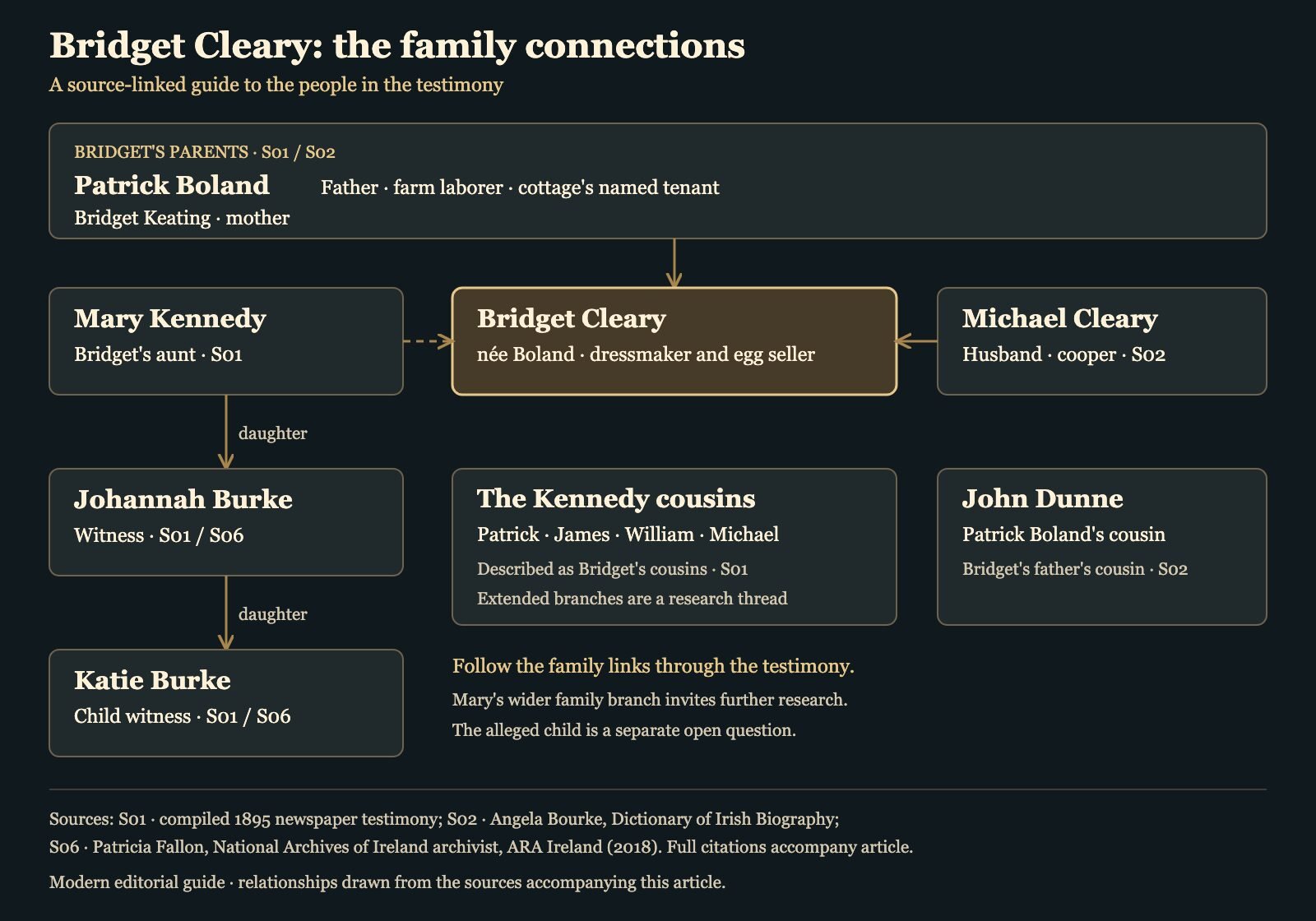
Patrick Boland was Bridget’s father. Mary Kennedy is identified as her aunt in the compiled reports, and the Kennedy men as cousins. Johannah Burke was Mary’s daughter; Katie Burke was Johannah’s daughter. Patrick Kennedy’s statement calls Bridget his first cousin and identifies James and William as his brothers. [S01]
Bourke identifies John Dunne as Patrick Boland’s cousin. Michael was Bridget’s husband. Put those relationships beside the testimony and you can see why the repeated surnames need untangling. A witness could be describing her mother, brothers, aunt, or cousin while also describing what happened to Bridget. [S02] [S01]
The family graphic below is a reading companion. Keep it nearby when you’re comparing the clippings. It makes the names easier to follow and gives us another question to think about: how did those relationships shape the pressure on people who later had to speak in court?
The disappearance account and the changing testimony
At first, newspaper readers were being told about a woman who had disappeared. Later, Johannah described instructions to say Bridget had left the house and that she didn’t know where she had gone. In the July coverage, she acknowledged an earlier false oath and said she had been afraid. Michael’s earlier denial and the questioning of witnesses are also preserved in the compilation. [S01]
It is worth reading those accounts in order. You can feel the story changing as more people speak and as their statements are challenged. What looked like a disappearance becomes something quite different.
I find the courtroom questions especially revealing. The lawyers were already arguing about the gap between seeing something happen and understanding what the people involved believed. That same question follows us through the whole case: how much of the fairy explanation was belief, how much was fear, and how much might have been useful to someone?
Murder versus manslaughter: what did the court decide?
The July report describes a change to a guilty manslaughter plea, accepted by the Crown and judge, followed by the jury’s manslaughter verdict. Michael received twenty years of penal servitude. [S01]
The distinction carried enormous consequences. Under the 1861 statute, murder carried the death penalty, while manslaughter allowed a range of punishments up to penal servitude for life. Manslaughter could therefore mean a very serious unlawful killing, rather than simply an accident. [S12]
For anyone wondering about the result after watching the video, the plea explains how the proceedings ended. Bagwell’s later letter offers one possible explanation for why the Crown accepted it: he thought a manslaughter outcome was preferable to risking a failed prosecution. He also acknowledged that he wasn’t in the Attorney General’s confidence. His view gives us something to weigh alongside the reported court proceedings. [S01]
What did twenty years of penal servitude mean?
Penal servitude meant life under the convict-prison system, with compulsory work, discipline, regulated food, and medical oversight. Research on Irish convict prisons from 1877 to 1895 shows how work and conditions varied between institutions. [S13]
For a physical example, Kilmainham Gaol Museum describes men breaking stones and women working in the laundry as hard labor. It helps put some weight behind an old sentencing phrase that can otherwise pass us by. [S14]
Bob Curran’s account of the case places Michael in Mountjoy and Maryborough prisons and dates his release on license from Maryborough to April 28, 1910. Curran also mentions accounts of him learning tailoring in prison. That last detail caught my attention, given Bridget’s own work as a dressmaker. It would be worth following up in his individual records. [S19]
The National Archives holds Michael’s penal record, GPB/PEN/1910/28, and a petitions file, CRF/1910/Misc/1619. Archivist Patricia Fallon’s guide describes the photographs, prison information, and petitions preserved there. They take the trail beyond the courtroom and into the years that followed. [S06]
The other woman, the alleged child, and what happened afterward
In his July 27, 1895 letter, jury foreman R. Bagwell relayed a local belief that Michael wanted another wife who could have children. He said he’d been told another woman had borne Michael’s child in Cashel workhouse. He left her unnamed. [S01]
That opens an intriguing possibility. Was the fairy explanation something Michael believed, something he could use, or both? Bagwell favored another motive, and his letter gives us a contemporary person close to the trial questioning the simple explanation. His prejudices and reliance on what he had been told are part of how I weigh his account.
The woman and child remain an open thread in this research. Fallon’s archive guide gives us Michael’s route after prison: Liverpool, then Canada. [S06]
I’m going to follow his later life through ancestry research for a separate article. The Canadian trail deserves room of its own, especially if it turns up answers about who he became after leaving Ireland.
The fire at the Kennedys’ house
The July coverage contains another disturbing report: the Kennedys’ house had been burned maliciously, supposedly by neighbors who wanted to prevent their return if they were acquitted. [S01]
This is the Kennedy family home, which is why I include it in the aftermath. The consequences were reaching beyond Bridget’s household into the homes of relatives involved in the case. If the reported explanation was right, public anger had become its own source of violence.
That leaves me wondering what awaited the people who eventually returned to the district. A sentence could end. Living among neighbors who remembered the case was another matter.
A detailed timeline of the Bridget Cleary case
- August 1887: Bridget Boland marries Michael Cleary, according to Bourke’s biography. [S02]
- Early 1890s: The couple moves into the newer laborers’ cottage with Patrick Boland, the named tenant. [S02]
- Early March 1895: Bridget becomes ill. Bourke describes bronchitis developing in the days after March 4. [S02]
- March 13: Dr. William Crean attends Bridget. In the compiled April evidence, he describes bronchitis, catarrh, and nervous excitement, and says he prescribed medicine. Johannah also reports herbs being given that day. [S01]
- March 14, evening: Witnesses describe the locked house, forced herbs and milk, restraint on the bed, and questions about Bridget’s identity. [S01]
- March 14, later that night: The reported treatment moves to the kitchen fire. Her father questions her too, and she is returned to bed. The later examination account names urine and water among the substances used. [S01]
- March 15, morning: Father Ryan celebrates Mass in the house, according to Johannah’s account. Bridget remains in bed. [S01]
- March 15, daytime and evening: Johannah describes helping at the house, Bridget’s request for neighbors to settle a difference, and the exchange over the shilling paid for milk. [S01]
- March 15, later that night: The account turns to tea, three pieces of bread and jam, more identity questions, and the fatal violence. [S01]
- After the killing, overnight into March 16: Johannah describes arrangements to remove and bury Bridget’s body and instructions about what people should say. [S01]
- The following days: Accounts of disappearance circulate. Bourke describes Michael keeping watch at the fairy fort, saying Bridget would return on a white horse. [S02]
- March 22: Bridget’s body is found during the police search. The compilation preserves the early discovery reporting. [S01]
- March 23 and the following reports: The inquest evidence and medical description enter the newspaper trail. The accounts begin to give readers a different explanation of her disappearance. [S01]
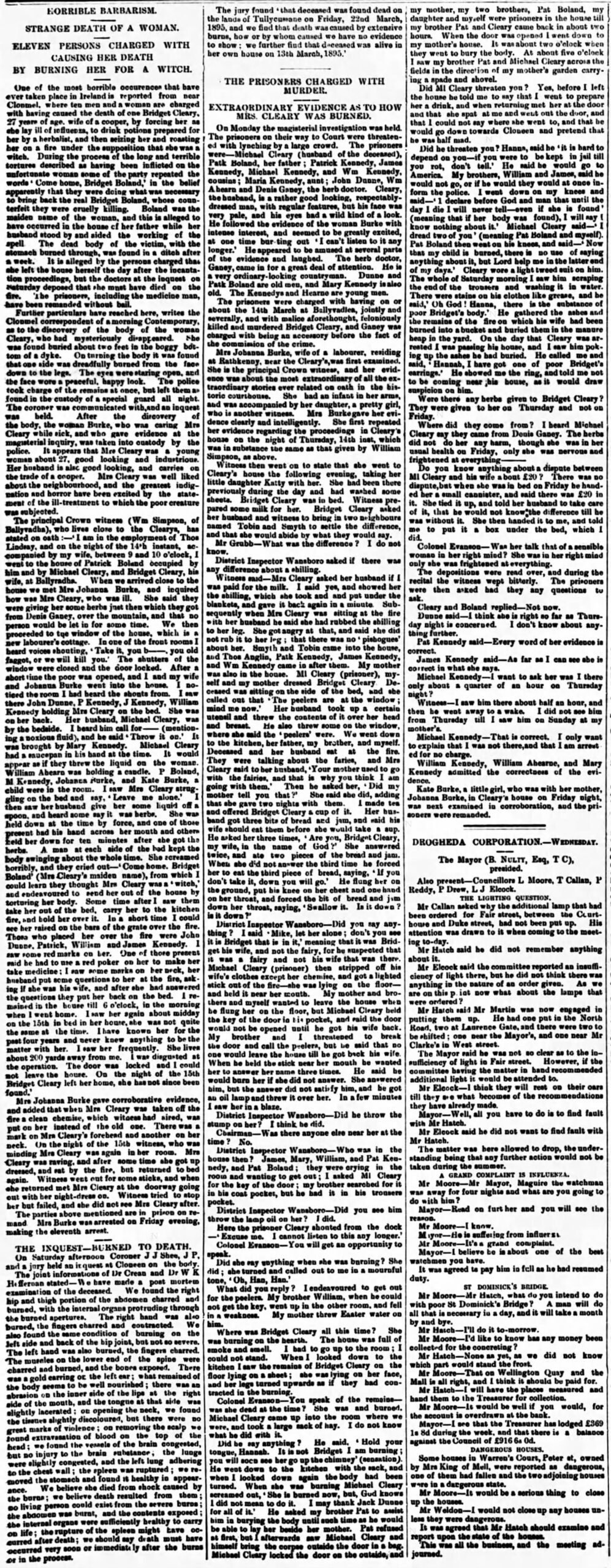
- March 27 coverage: Detailed reporting of Johannah’s account appears, including the household questioning, bread and jam, and concealment. The issue date identifies the report, rather than every event described in it. [S01] [S03]
- March 28 coverage: The child’s reported evidence gives another perspective on the house and the adults around Bridget. [S01]
- April 2 and April 5 to 6 coverage: Further examinations bring witness questioning, police inquiries, medical evidence, and disputes over what the treatment meant. [S01]
- Early July: The trial proceeds. July reporting describes the manslaughter plea and sentences, including Michael’s twenty years of penal servitude. The July 6 report also carries the news about the Kennedys’ house. [S01]
- July 27: Bagwell writes to E. Clodd with his interpretation of the case, the alleged other woman and child, and his doubts about superstition as the main motive. [S01]
- April 28, 1910, in Curran’s account: Michael is released on license from Maryborough. Fallon’s archive guide describes his subsequent journey through Liverpool to Canada. [S19] [S06]
Read the clippings and follow the trail
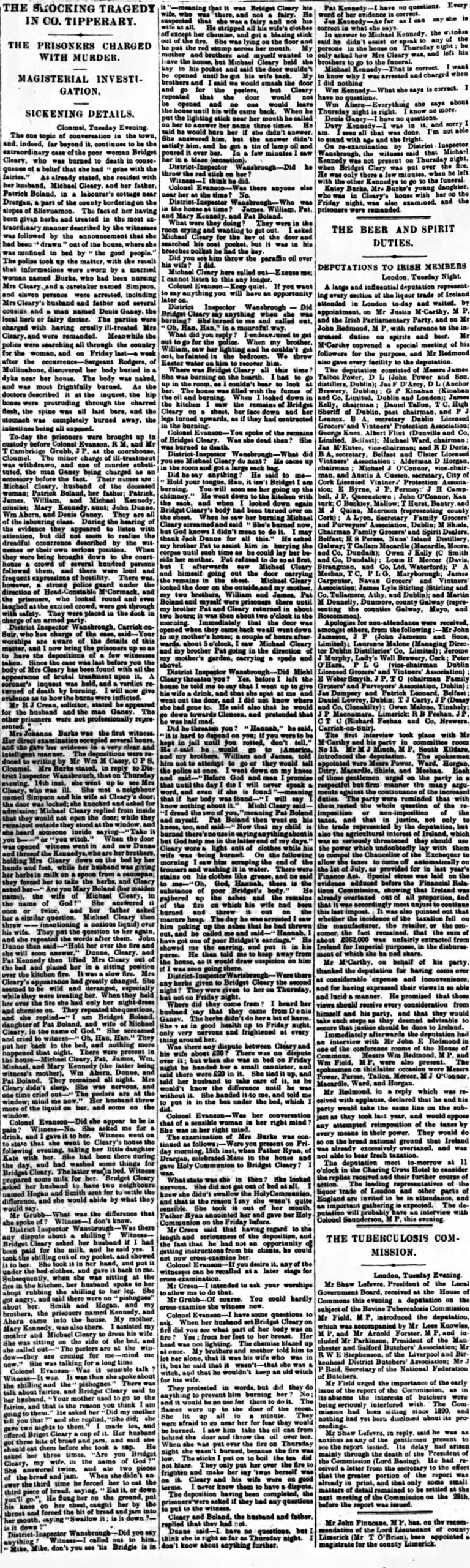
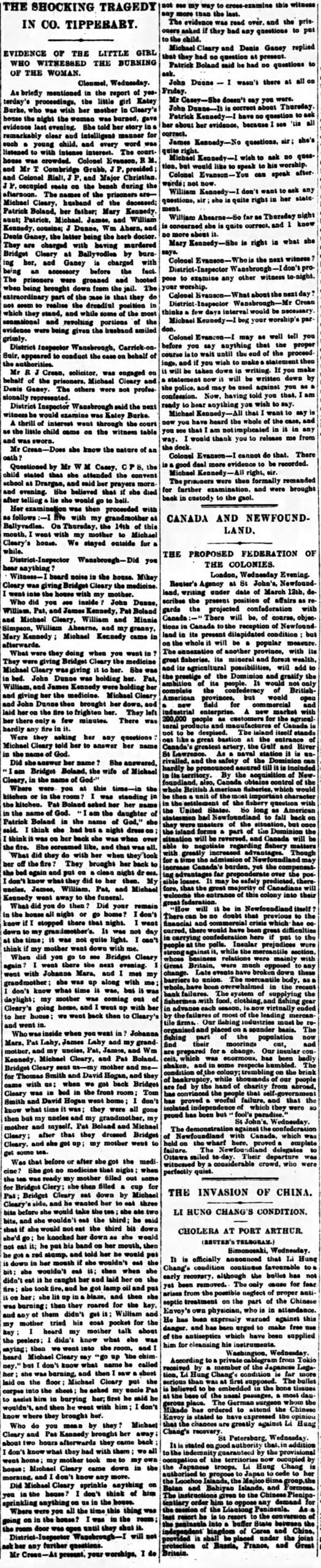
The gallery below contains three of the newspaper images I gathered, including the main witness account and the child’s reported evidence. Open an image for a closer look. Publication details are retained from the saved files, with the source notes below for anyone who wants to trace them further.
The McGill collection on Internet Archive brings together newspaper accounts and correspondence in a typescript cataloged as 1917. It is a handy way to follow the reports across the investigation and trial. For the next layer, Patricia Fallon’s archive guide points to court files, police correspondence, prison records, petitions, and photographs. [S15] [S06]
What stays with me is Bridget’s voice in the middle of all this. She answered, resisted, argued, and called other people into the conversation. Perhaps the reference to the police was one more attempt to get someone to treat her as a woman who needed help.
What do you make of that moment? Do you hear an appeal for care, a warning that the police might intervene, or something else? And which detail changed the way you understood the story once you looked beyond the fairy explanation?
Newspaper reading gallery
Open a clipping to read the complete image, or choose its original file. These historical accounts include descriptions of violence.
Sources and evidence notes
- S01 · The Tipperary (or Clonmel) witch case: owner-supplied EPUB
EPUB page_6–8 (Bagwell); 10–18 (early reports); 22–32 (Johannah); 38–42 (Katie); 64 (urine/water); 88 (Ganey discharge); 90–92 (denial); 102 (nine cures); 108 (Patrick Kennedy); 130–134 (trial). These are EPUB indexes, NOT original newspaper pages.Research notes
OCR/transcription can contain errors. Attributed paraphrases; no invented exact dialogue. July account does not establish the official rationale for the plea.
- S02 · Angela Bourke, Cleary, Bridget, Dictionary of Irish Biography (October 2009)
Family, work, marriage, labourers’ cottage and John Dunne’s relationshipResearch notes
Facts paraphrased in original prose, not reproduction of CC BY-NC article; no exact age or full genealogical branch asserted.
- S03 · Owner’s March 27 clipping, The shocking tragedy in Co. Tipperary
Left column location; middle column lamp/paraffin wordingResearch notes
Publication/date comes from owner filename; issue header and original page not in crop. Missing metadata waived by owner, not invented.
- S04 · NLS, Tipperary Sheet 63, second edition (1906)
Header inspected previously: second edition 1906, Sheet 63; registered archival asset 6Research notes
Filename is not date evidence. Broad orientation only; exact cottage/fort unverified.
- S05 · Lady Wilde, Fairy Nature, Ancient Legends, Mystic Charms, and Superstitions of Ireland (1888 edition)
Hills, raths, offerings, help and harmResearch notes
Evidence of collected lore, not universal Irish belief or supernatural fact. Contains prejudiced racial/national generalizations not adopted here.
- S06 · Patricia Fallon, National Archives of Ireland archivist: Bridget Cleary murder trial records (ARA Ireland, Spring 2018)
Printed pp.19–22 (PDF indices18–21); p.20 Liverpool/Canada and GPB/PEN/1910/28; p.22 CRF/1910/Misc/1619Research notes
Guide checked, complete original prison/convict files not inspected. No Montreal, named child, later marriage, or exact release date established by it.
- S07 · Lady Wilde, The Fairy Doctor (1888 edition)
Herbs, prayer, hazel ritual; vervain, eyebright, yarrowResearch notes
Context only, not Ganey’s recipe or a medical recommendation.
- S08 · Lady Wilde, The Fairy Doctress (1888 edition)
Female practitioner, secrecy of plant and treatmentResearch notes
Folklore story, not proof of successful treatment or Cleary ingredients.
- S09 · Victoria and Albert Museum: Victorian underwear and A Chemise for Clean Comfort
Chemise/shift underlayer; linen example and cotton chemise exhibition listingResearch notes
General clothing context, not identification of Bridget’s garment fabric.
- S10 · Ullapool Museum / Museum of the Highlands, Paraffin Lamp
Paraffin/kerosene lighting fuel; coal then petroleumResearch notes
Scottish object dated1900–1910, not Bridget’s lamp. Museum photograph not reproduced.
- S11 · Garda Síochána Historical Society, George Warburton: County Clare’s First Professional Policeman
1814 Peace Preservation Force, nickname peelers after PeelResearch notes
Term history, not proof that police were at the window in the disputed account.
- S12 · Irish Statute Book, Offences Against the Person Act 1861, sections 1,5,6
Historical homicide penalties and indictment language; indexed statute text checkedResearch notes
Historical context only; not present-day legal advice or a complete explanation of the Cleary plea.
- S13 · Medical Officers, Bodies, Gender and Weight Fluctuation in Irish Convict Prisons, 1877–95, Medical History
Irish convict health, diet and labour; institutional differencesResearch notes
Period system context, not Michael’s individual prison diary.
- S14 · Kilmainham Gaol Museum, Prison Life
Stonebreaking and laundry hard-labour examplesResearch notes
Not evidence that Michael did these particular tasks or served at Kilmainham.
- S15 · Internet Archive / McGill item catalogue
Publication date1917; typescript presented by Dr George FoyResearch notes
Catalogue date is distinct from1895 reports and later copy annotations.
- S16 · Dúchas, Main Manuscript Collection, CBÉ 0554 (Part 3): fairy-stroke and protective treatments
Item dated September 17, 1938; informant Eilís Bean Uí Chonchubhair; online transcript describes urine protecting women after childbirth from fairy abduction and a separate three-part Christian invocationResearch notes
Collected 43 years after the Cleary case, used as comparative folklore. Does not prove what every participant intended in 1895. Paraphrase only; manuscript image not independently transcribed here.
- S17 · Magnus Course, Changelings: Alterity beyond difference, Folk Life 55(1), 2017, pp.12 to21
Accepted manuscript, especially PDF pages6 to10: appetite, refusal of human food, sacrament, third repetition and Cleary caseResearch notes
Author’s analysis, not witness testimony or proof of Michael’s private intention. Original synthesis, no copied passage.
- S18 · John 21:15 to17 and notes, USCCB Bible
Three questions to Peter; note connects threefold confession with earlier denialsResearch notes
Supports biblical parallel only. No source found naming Peter’s denial as the historical origin of the Cleary questioning. Trinity invocation is directly recorded in testimony.
- S19 · Bob Curran, The Last Irish Witch, Old Moore’s Almanac, June 19, 2013
Closing paragraphs: Mountjoy/Maryborough, release on license April 28, 1910, reported tailoring, travel to CanadaResearch notes
Attributed published account. Original prison file not obtained; tailoring is introduced by Curran as according to some accounts. No daily routine, Canadian identity match or reunion invented.
- S20 · Celtic Studies Resources, Bridget Cleary: Fairy Intrusion in Nineteenth Century Ireland, October 13, 2007
Discussion following third dose: urine as a way to force changeling to leave, citing Bourke; comparison with1895 Folklore reportResearch notes
Used narrowly for urine interpretation, not copied generalizations, certain motive or incidental name errors.
Open research questions
- Exact herb recipe
- Identity of unnamed Friday liquid
- Woman/child named in Bagwell hearsay
- Verified later reunion, marriage or Canadian address
- Michael’s exact release date and individual daily prison routine
- Complete civil/parish family tree
- Exact cottage and story-fort coordinates
- Gallery issue/page authentication where crop lacks header
